

As fishing techniques continue to evolve and become ever more effective, have you honed in your craft on the latest styles of fighting and landing big fish from a small boat?
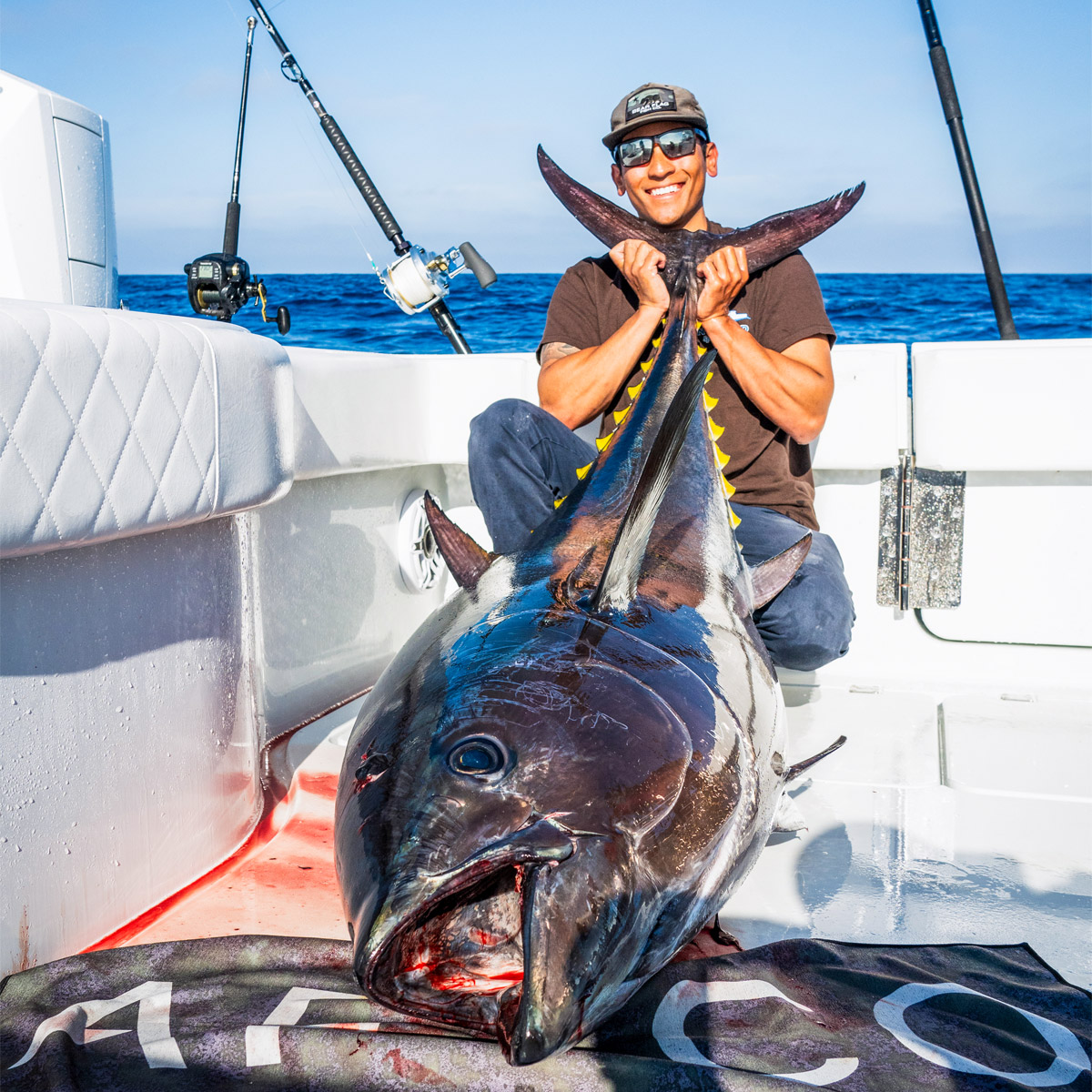
Over the past decade, Southern California has become the mecca for targeting trophy Pacific Bluefin Tuna. For both seasoned anglers and weekend warriors alike, catching that once-in-a-lifetime cow Bluefin Tuna has likely become a reality in recent years. If you're still looking to catch that 200+ pound Bluefin in our local waters, it's not too late. Our season is just beginning, and more and more tuna are starting to filter into our local waters.
Given all the time, money, and preparation we anglers invest in pursuing these fish, it's only sensible that we invest in the proper gear and arm ourselves with the knowledge of the latest techniques for fighting and landing big Bluefin. As we've witnessed firsthand over the past ten-plus years, our fishery is constantly evolving and we must evolve with it or risk falling behind the curve. This article will cover the equipment and techniques necessary to successfully fish a rail rod from a skiff.
Choosing the Right Rail Rod
First off, let’s discuss what exactly a rail rod is, how a rail rod works, and how, as an angler, you might go about choosing one that is right for you. In the context of this article, a rail rod is a setup you would use when targeting our local fish anywhere from 100-300+ pounds. They are generally slightly longer than traditional stand-up rods in order to provide boat clearance when utilizing the rail, and are built with extended fore-grips to protect the rod blank, but more on this later.
When considering the factors for selecting an appropriate rail rod for fishing from a skiff, an angler must first take into account their physical build, fishing experience, equipment, and style of boat. For example, a larger angler may be able to handle more load on a heavier rated rod when compared to a lighter angler. If your boat or rails sit very high off the surface of the water, you might consider a slightly longer rod to ensure line clearance when fighting a fish from the rail, and vice-versa in the opposing scenario.
Your fishing technique will also help to determine which rail rod will be best to fish from your skiff. Along with personal angler preference, there are rods best suited and built for different fishing applications. If you are going to be trolling lures, such as Madmacs or Spreader Bars, you might consider a trolling rod constructed with roller guides. On the other hand, if you will mainly be fishing with kites and helium balloons, a more conventional style rail rod will suit your needs best.
When we take a moment to look at how a rail rod is meant to function, we quickly realize the benefits of using one versus traditional rods and old school techniques. Fishing rail rods from skiffs allows us to use our boat and its rails as a fulcrum point, providing us with an immensely strong point to leverage off of.
Learning how to utilize the rail when fighting big fish will empower anglers to fish more drag on their reel and apply exponentially more pressure on the fish than would be possible with a traditional stand-up rod. Rail rods allow us to do this because they take the strain of pulling on a big fish off our arms, and allow us to utilize the boat, swell, and our body weight as leverage against the fish.
Much like using a harness, you will be surprised how much more pressure you’ll be able to put on these trophy Bluefin when using a rail rod. The rail rod provides you even more maneuverability than a harness would for when that fish decides to dive under the boat or forces you around the boat’s pulpit or outboards. All things considered, fishing a rail rod from a skiff allows you to put the maximum amount of pressure on the fish without having to be confined and locked into a fighting belt or harness.
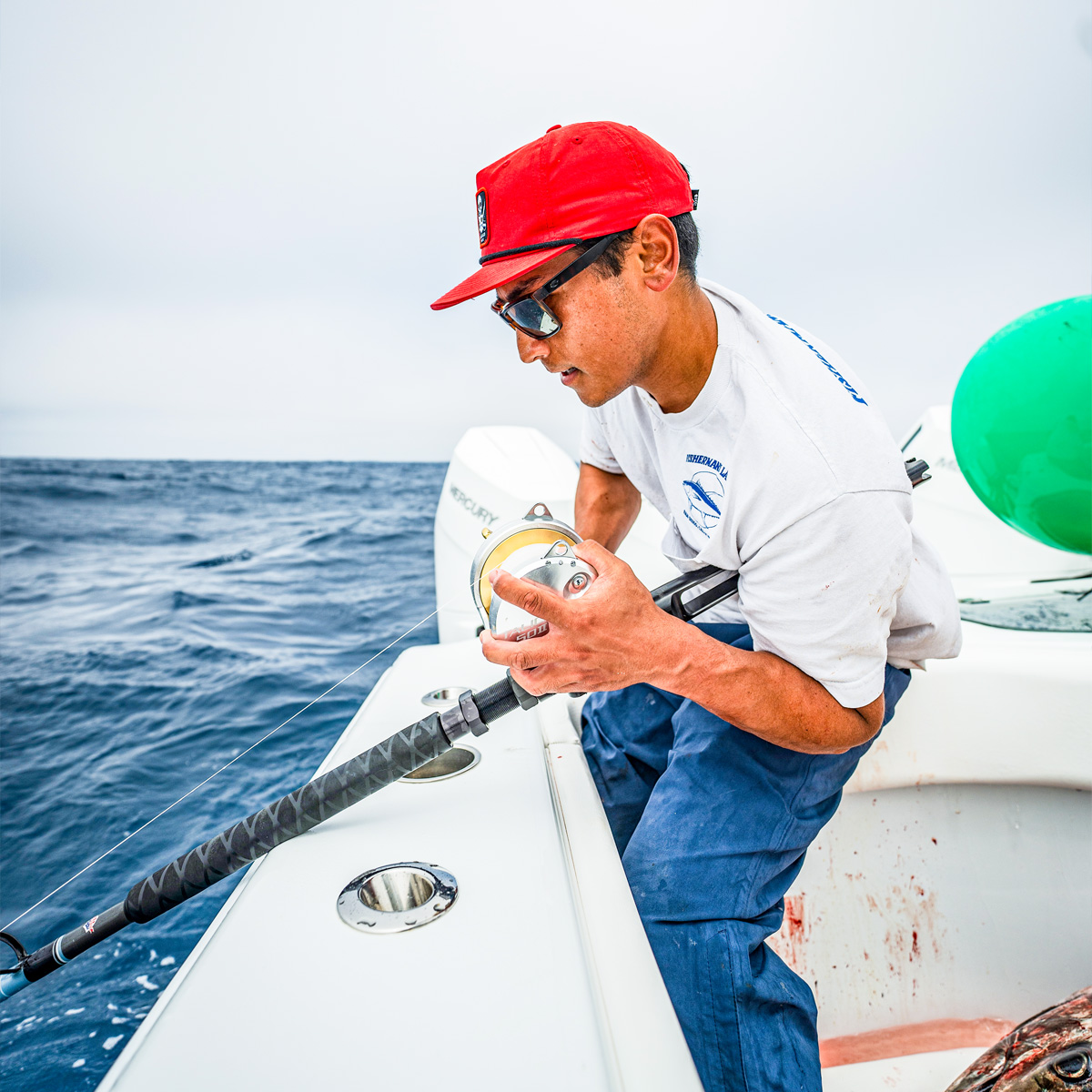
In case you’ve never used a rail rod, here’s a brief rundown of the proper technique. Once you’ve hooked a fish, depending on whether your line is scoped out away from the boat or the fish is straight up and down, you’ll be using either the inside or outside of the rail respectively However, the technique and form don’t vary greatly from there. Find a comfortable spot to tuck the butt of the rod in your underarm, place the fore-grip on the rail to act as your fulcrum, and use your non-reeling hand to palm the side of the reel for stability.
Once you are in position on the rail, the difficult and slow process of gaining line begins. However, you will be much more comfortable than if you were fishing in traditional stand-up gear. Begin using your body weight and the natural motion of the swell to apply downward pressure on the butt of your rod. This loads it up and begins to bring the rod tip away from the water’s surface. Once your rod is fully loaded up, purposefully and slowly lower your rod tip towards the fish while simultaneously cranking on the reel. It is imperative that you keep the rod loaded and continue to maintain constant pressure on the fish, even when gaining line back onto the reel.
When it comes to rail rods, there is no one-size-fits-all option that will work for every angler. You must take into account a variety of factors, like the ones discussed above, each of which will dictate what rail rod is going to be most effective for you. As with all things in life, practice makes perfect, and the more you begin to use the rail, the more versed you will become in seizing every opportunity to gain line and get that fish in the boat.
Rail Rod Blank and Design
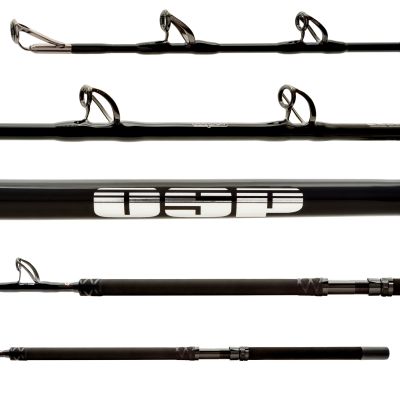
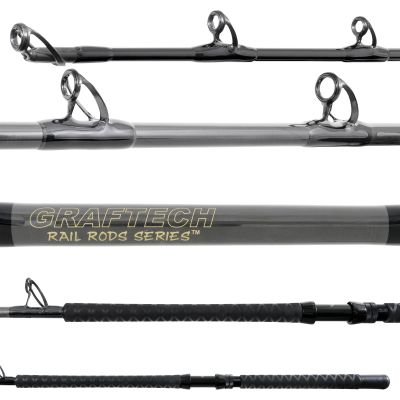
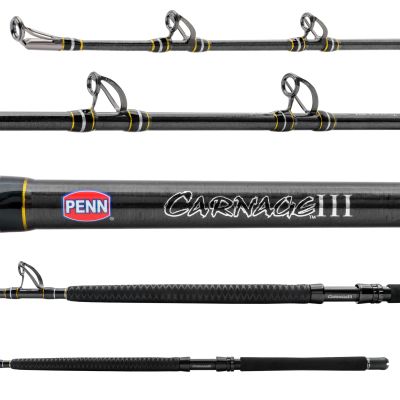
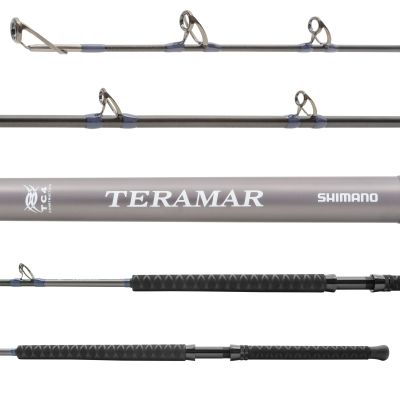
Rail rods are intentionally designed and built to be fished with the extended foregrip serving as the fulcrum point resting on the rail when fighting fish. The blanks generally vary in length from 7’-8’ and are wrapped with an extended butt section for leverage, beefed up foregrip to protect the blank, and heavy-duty aluminum reel seats and guides. You may notice that the reel seat is placed slightly further up the rod than your conventional stand-up fishing rod, as this helps give the angler even more leverage when using the rail.
As anyone who has hooked and pulled on a cow tuna will tell you, they are extremely strong fighting fish. Rail rods are designed to tackle large-game, which means the blanks must possess a stiff backbone but also a soft tip to absorb big headshakes throughout the fight. However, as previously mentioned, when we use the rail to our advantage, we can apply extreme amounts of pressure to the fish. Therefore, most rail rods will generally have a heavier rating than your standard stand-up fishing rods.
For fishing a rail rod from a skiff, we have found that a rod in the 7’-7’6” range performs extremely well. The shorter rod applies less strain on the user but is still long enough to keep the line away from the hull of the boat and navigate around the bow and outboards in the stern if necessary. If your skiff has a higher freeboard, you might consider a slightly longer rod to provide you with the appropriate amount of clearance.
You’ll want to check out a variety of rail rods before finally choosing one (or a whole set) for your skiff. Look for one that was wrapped with quality materials, from the heavy-duty guides to the aluminum reel seat and foregrip material. Ensure that the rear grip feels comfortable because it will be tucked in your underarm for a vast majority of the fight. While this is rarely an issue, make sure that your reel is compatible with the rail rod that you choose. There are many options available on the market today, which is great news for anglers looking to get the perfect rail rod, but the configuration of the rod ultimately depends on your own personal preference, fishing style, and physical ability.
Rail Mounts and Rod Holders
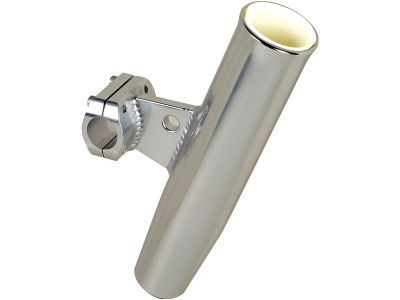
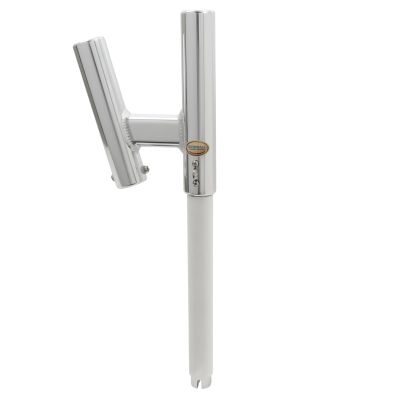
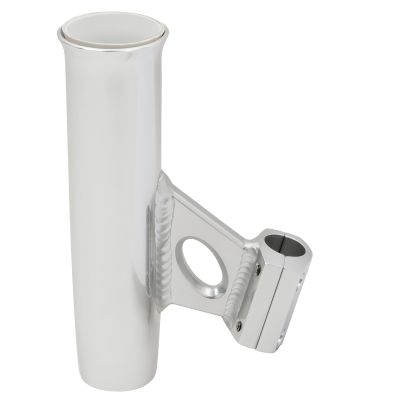
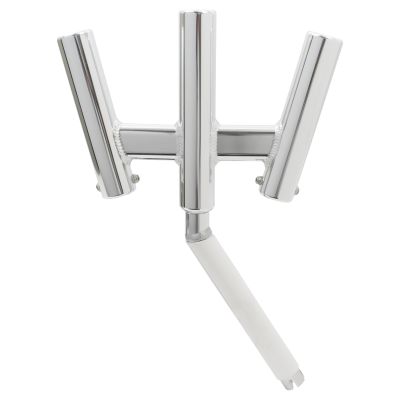
We all know that storage on boats, especially skiffs, can be extremely limited. To bring all the necessary gear on an offshore trip, it would be wise to look into acquiring extra rod storage for your skiff, whether that is rail-mounted rod holders or dual/trident rod holders that can fit into existing rocket launchers.
Depending on the build of your skiff, it may be most efficient to have dual or triple rod holders that easily fit and lock into existing ones, instantly providing you with more rod storage and easy access to your rail rod, kite rod, etc. If your skiff has bow rails and you want to be able to quickly access rods on the bow while you are fishing, there are plenty of clamp-on rod holder options available depending on the diameter of your rails.
Additionally, the mounted rod holders or even the dual/triple rod holder mount can suffice in helping to secure your rod in place while you are fighting a fish on a rail rod. There have also been systems and accessories introduced in recent years designed specifically for skiff anglers who fish rail rods.
Rail Rod Accessories
When using a rail rod from a skiff, it is sometimes necessary to kneel in order to get the most leverage out of the rod, even though it may not be the most comfortable position for the fight. As we have begun to use the rail rod technique more and more over the years, we have become innovative in using rail mounts and rod holder mounts to our advantage for securing the rod in place throughout the battle.
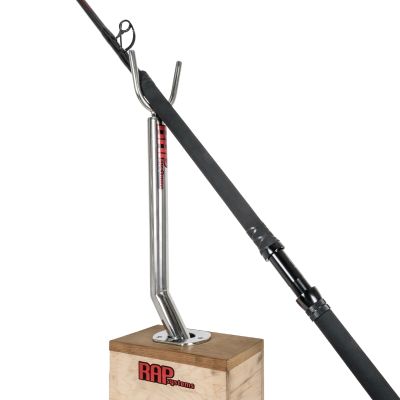
There have also been systems and accessories (i.e. The Rad Rail, RAP Systems, etc) introduced in recent years, designed specifically for skiff anglers who fish rail rods. The RAP Systems Rod Assist Pipes have proven to be extremely helpful in making fighting fish with rail rods both more comfortable and more effective. They are available in three different angles and lengths and have a 360 degree, swiveling, U shaped seat to serve as the fulcrum point where your rod will sit.
Conclusion
When it comes to fishing a rail rod from a skiff, time on the water and arming yourself with the proper gear will make a world of difference. The more an angler uses the rail, the more they will be able to dial in their technique. It is a more comfortable way to endure long-winded battles with big game, and is a technique that can be applied across all fisheries. You will be amazed at the amount of pressure that you are able to put on fish using this method, and hopefully, it will lead to quicker battles and more fish on your deck.