

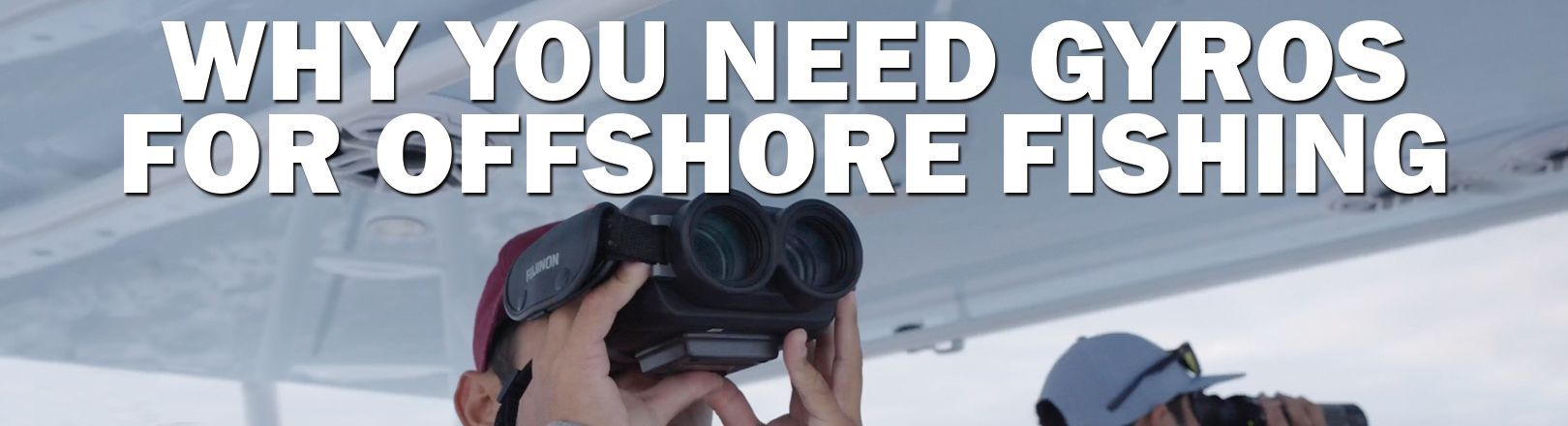
Gyroscopic stabilized binoculars should be an integral piece of equipment for every serious offshore fisherman around the country. They allow you to see far beyond what you might be able to pick up with the naked eye, and with the help of stabilization technology, gyro binoculars deliver the user a clear image of what’s on the horizon.
There are plenty of marine-grade binoculars on the market today, ranging in prices from about $600 for basic 7x magnification to upwards of $5,000 for gyro-stabilized 12x, 14x, or 16x magnification. Military-grade gyroscopic technology certainly comes with a hefty price tag, but as anyone who owns and uses a quality pair of gyro binoculars on the water will tell you, it’s not worth leaving the dock without them. Some days your gyro binoculars will help you find more fish than your side-scan sonar and up-and-down fishfinder combined, and you’ll quickly see why you couldn’t go without them.
What are Gyro-Stabilized Binoculars?
To understand why gyroscopic stabilized binoculars are so useful, we first have to consider their counterparts. Basic marine binoculars possess 7x magnification and offer no stabilization. The reason they do not exceed 7x magnification is that any stronger than that and they will become virtually useless on the water as even calm seas and shaky hands will make them impossible to use effectively.
Gyro-stabilized binoculars, on the other hand, can offer 12x, 14x, 16x, and even 18x magnification. This is possible because gyro binoculars effectively cancel out any movement caused by ocean swell or hand tremors. Without stabilization, binoculars with this high magnification would be jittery and difficult to use even on dry land, let alone in rolling seas. The higher the power, the more magnified the movement.
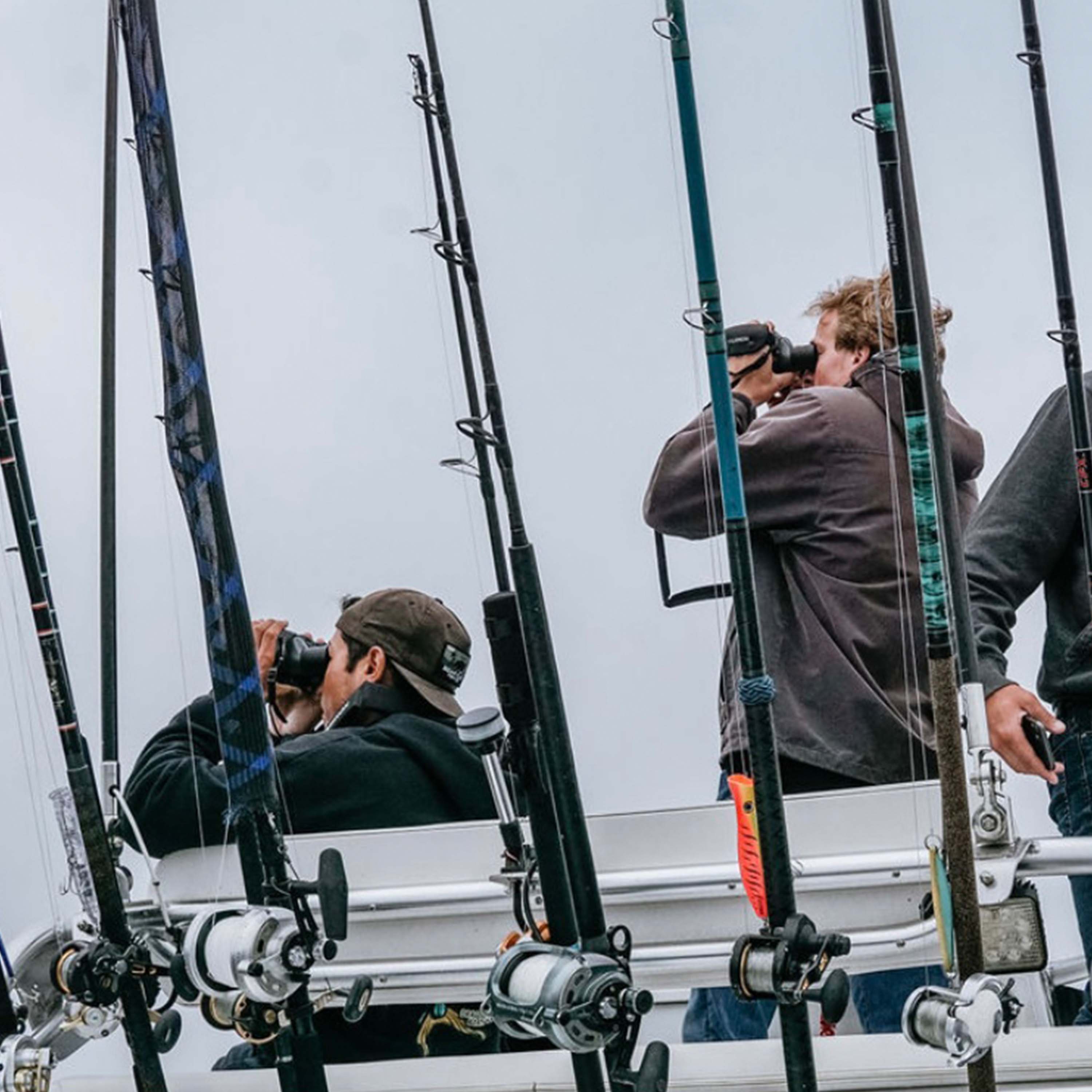
With gyro binoculars, we can now effectively see for miles beyond what the naked eye is capable of, achieving a steady and clear image in our binoculars that greatly enhances our ability to search for productive waters while fishing. To put it into perspective, on a relatively clear day offshore with relatively small swell, the average angler may be able to spot a bird school or tuna foamer from about a mile away. On a gloomy day with large seas, this distance can be cut in half or more. With a pair of 16x magnification gyroscopic binoculars, you have a great shot of spotting a bird school at 4-6 miles out, and a trained user of gyros could be able to spot them at up to 8 miles away.
Understanding the Technology Behind Gyro-Stabilized Binoculars
Procured from military technology, these high-powered binoculars possess internal battery-powered gyroscopic stabilizing systems that prevent the image from bouncing around and provide the user with a stable field of vision even in high seas. This enhanced stabilization, in turn, allows for greater magnification, allowing anglers to see further and more clearly than ever before while out on the water.
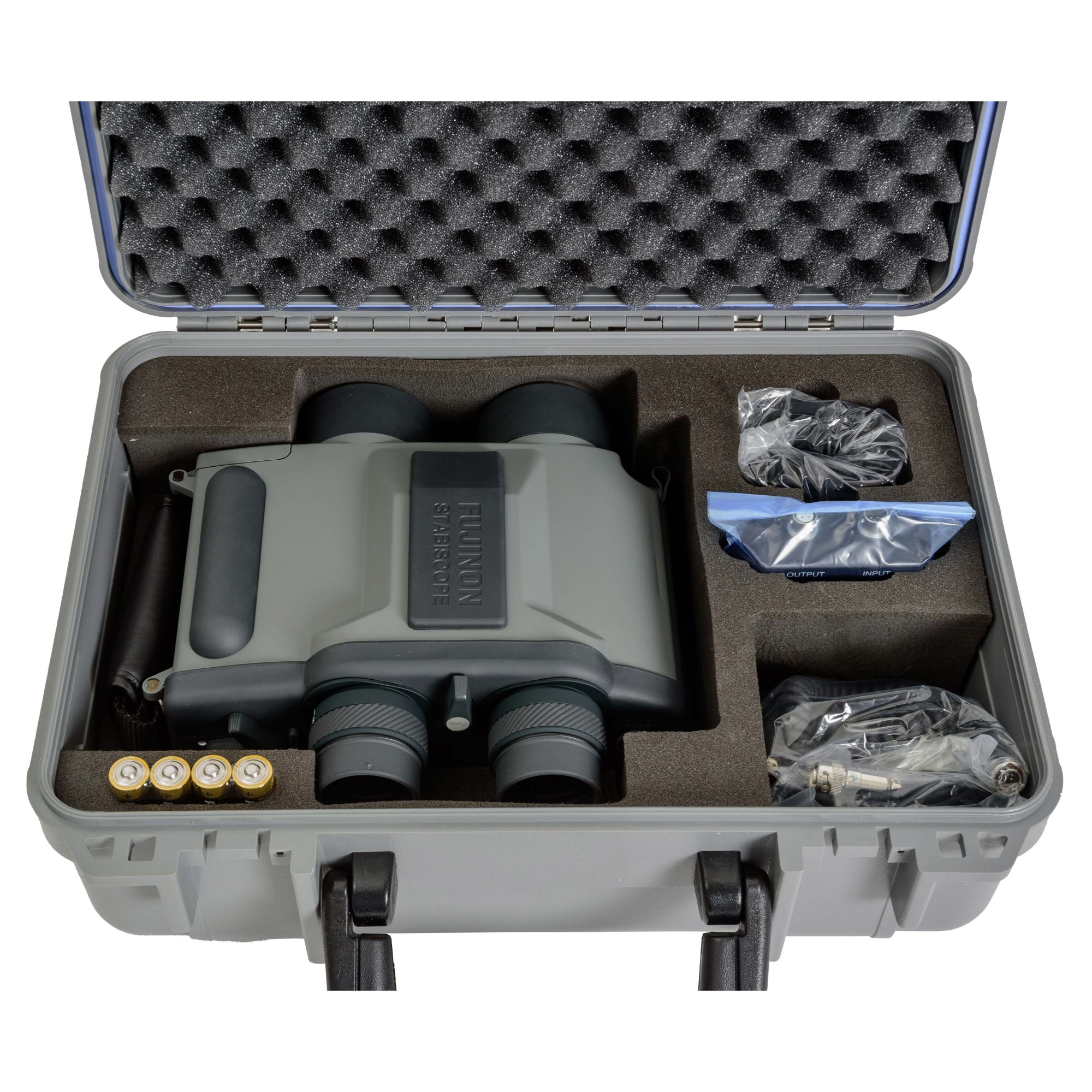
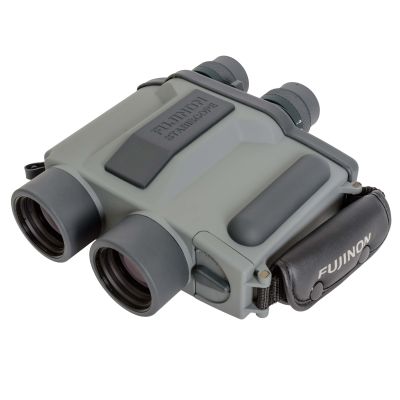
One important factor to note is that, while both effective and incredibly useful on the water, gyroscopic stabilization and image stabilization do not work in the same way. Gyro-stabilized binoculars such as the Fujinon Stabiscope Binoculars and Fraser Optics work by utilizing an internal gyroscope which provides a stable reference that is used to move prisms and counteract any motion that is detected. Image stabilizing binoculars such as Fujinon Techno-Stabi TS-X 14X40 Binoculars utilize an electronic gyro stabilizing system which detects vibrations or movements and corrects them by sending commands to adjust the prisms to counteract any motion.
To put it simply, it’s essentially two different means to an end, and unless you are a tournament fisherman who spends more days on the water than on dry land, there’s really no need to be too concerned with the specifics. Gyro-stabilized binos are generally going to carry a higher price point than image-stabilizer binos, but both work extremely well, especially with the continuous advancements in technology. As someone who has personally used each type for extended periods of time, I can honestly say I swear by them both, and the only negative I can pull from either is that I’ve had to service my true gyro-stabilized binos more frequently than my image-stabilizer binos.
Factors to Consider When Choosing Gyro-Stabilized Binoculars
If you’re wanting to get technical when picking out the right pair of gyro binocs for you, there are a few important factors to consider such as exit pupil size and range of compensation. The exit pupil measurement is the width of the beam of light leaving the eyepiece. A larger exit pupil size (most commonly measured in mm) will provide a brighter image to the user in low light conditions and vice versa. Generally, stronger magnification within a pair of binoculars correlates to a smaller exit pupil size and slightly darker image. I have personally never experienced any issues with small exit pupil sizes, but it’s something to consider if you plan to use your binoculars in very low-light or dark conditions often.
The range of compensation varies between each brand and model of gyros. They tend to vary from 2 to 6 degrees with true gyroscopic stabilizing binos being on the higher end of the range. This really only comes into play on extremely rough weather days when binoculars with only 2 or 3 degrees of compensation can become difficult to use as they struggle to keep up with visual adjustments.
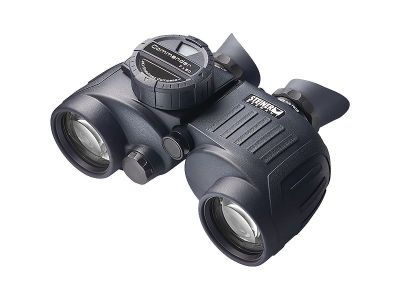
Another thing to consider when looking for gyro binoculars is brand reputation, manufacturer precision and quality standards, and potential warranties. Bar none, Fraser Optics and Fujinon are the leading brands in this field. All of their products are at the very least water-resistant, with most being fully waterproof, and many models even float. In my humble opinion, it is well worth spending the extra money to purchase a product from a tried and true manufacturer.
The most obvious barrier to entry when looking at gyro binoculars is the price tag. Be prepared to spend anywhere from $1,300 to $5,000+ on a pair of quality stabilizing binoculars. But like I mentioned earlier, anyone who has experience using them will tell you that they are an absolute must-have and well worth the price. For someone looking to purchase a pair of gyro binoculars on a budget, I’d recommend checking out image stabilizing binos like the Techno-Stabis from Fujinon. For anglers operating out of an open checkbook, Fraser Optics or Fujinon’s Stabiscope binos should definitely be on your boat.
Conclusion
● Try to keep the sun behind you as best you can when “glassing” the water for signals. There’s nothing worse than staring through a magnifying glass into the sun.
● If you have a tower, use it! Getting to a higher vantage point increases your range of vision even further.
● If you have to put the gyros down after spotting fish, get a relative heading to the direction you were looking first.
● Finding foaming fish is great, but birds are key. On days when the ocean seems lifeless, finding a couple of white tern birds dipping can lead you straight to a school of fish.
● Invest in eye cups to keep the glare away. After the first time I used them, I’ve never looked back.
Truth be told, if you consider yourself a true offshore fisherman, then you need to invest in a pair of gyro binoculars. The ability to functionally increase your range of vision by miles will undoubtedly lead to you finding and catching more fish than the other guy.